
Your doctor mentions it’s time for colon cancer screening, and suddenly you’re staring at two options with names that sound almost identical: flexible sigmoidoscopy and colonoscopy. Both involve a thin, flexible tube with a camera. Both check for the same kinds of problems. And yet the actual experience, the prep, and what each one can and can’t find are different enough that picking the right one genuinely matters.
Why This Comparison Trips People Up
Both procedures use a lighted, flexible scope inserted through the rectum to examine the lining of the colon. Both can detect polyps, inflammation, bleeding, and early signs of cancer. Both require some form of bowel preparation beforehand. On paper, they look like two versions of the same test, which is exactly why patients assume they’re interchangeable.
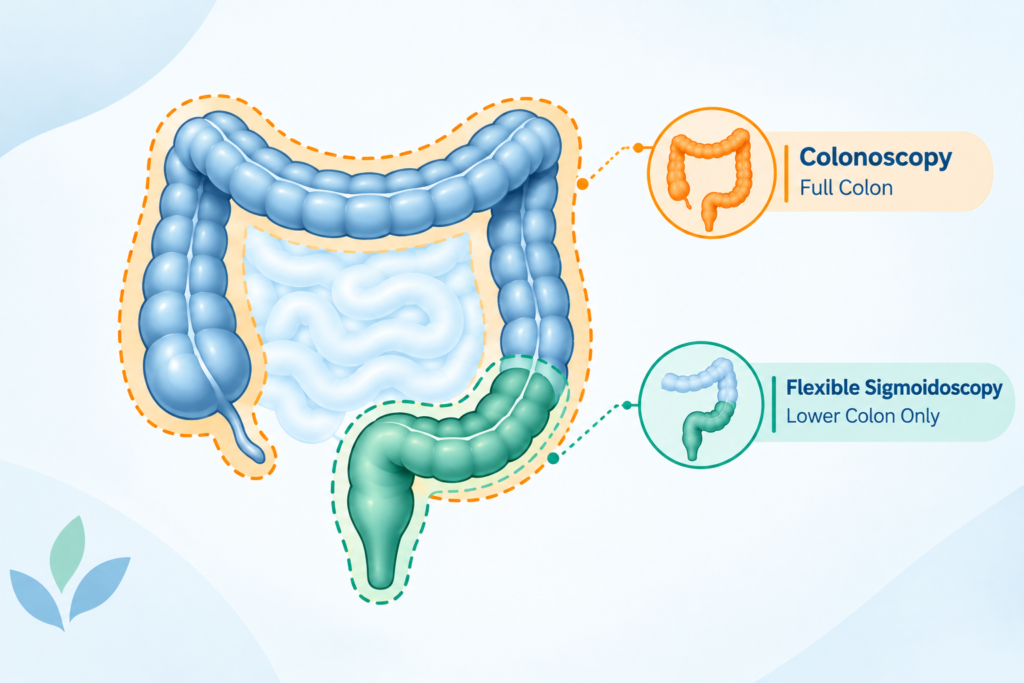
They’re not. The core difference comes down to how much of the colon each procedure actually reaches, and that single distinction ripples out into differences in prep, sedation, accuracy, how often you need to repeat the test, and even cost.
What Is a Flexible Sigmoidoscopy?
A flexible sigmoidoscopy examines the rectum and the sigmoid colon, which is the lower, S-shaped section of the large intestine closest to the rectum. In practice, that typically covers the last one to two feet of your colon, roughly the final third.
The procedure itself is relatively quick, usually taking somewhere around 10 to 20 minutes. Because it only examines a limited section, sedation often isn’t required, though some patients prefer a mild sedative anyway simply to stay more relaxed and comfortable throughout. Most people are back to their normal routine within a few hours, sometimes the same afternoon.
What Is a Colonoscopy?
A colonoscopy examines the entire length of the large intestine, from the rectum all the way up through the sigmoid colon, descending colon, transverse colon, and ascending colon to where it connects with the small intestine. It’s a considerably more thorough look at the full colon, not just the lower section.
The procedure generally takes 30 to 60 minutes and is performed under sedation, since the scope travels much further and most patients wouldn’t be comfortable staying still and relaxed for that duration otherwise. Recovery typically involves resting for the remainder of the day as the sedation wears off, and you’ll need someone to drive you home afterward.
Side-by-Side Comparison
| Flexible Sigmoidoscopy | Colonoscopy | |
|---|---|---|
| Area examined | Rectum and lower third of colon (sigmoid colon) | Entire colon, rectum to cecum |
| Procedure length | About 10–20 minutes | About 30–60 minutes |
| Sedation | Often not required | Standard practice |
| Bowel prep | Lighter, often just an enema or limited prep | Full prep, typically a liquid diet plus a prescribed prep solution |
| Recovery time | Minimal, often same-day return to normal activity | Rest of the day, need a ride home |
| Polyp removal | Possible, but only within reach of the scope | Possible throughout the entire colon |
| Recommended screening interval | Every 5 years (often paired with annual stool testing) | Every 10 years for average-risk patients |
| Ability to detect issues beyond the lower colon | No | Yes |
| Typical use case | Limited screening, symptom-specific evaluation, or when colonoscopy isn’t an option | Comprehensive colon cancer screening, follow-up on abnormal results, higher-risk patients |
The Real Difference: Coverage Matters More Than It Sounds
It’s easy to glance at that comparison and think flexible sigmoidoscopy sounds like the more convenient choice, shorter, lighter prep, no sedation needed. And for certain situations, it genuinely is the right call. But the coverage gap is a real clinical consideration, not a minor technicality.
Colon polyps and early cancers can develop anywhere along the length of the colon, not just in the lower third. A flexible sigmoidoscopy simply can’t see into the ascending or transverse colon, the sections further up. If a polyp or early cancer happens to be sitting in one of those unreached areas, a sigmoidoscopy alone won’t catch it, no matter how thorough the exam of the lower colon is.
This is part of why some research has pointed to a higher rate of missed or later-diagnosed colorectal cancers in patients who were screened with sigmoidoscopy alone, particularly cancers located in the parts of the colon the scope doesn’t reach. That’s not a reason to think sigmoidoscopy is a poor test. It’s a reason to understand exactly what it does and doesn’t cover before choosing it as your primary screening method.
Bowel Prep: What to Actually Expect
Prep is often the deciding factor for patients choosing between the two, so it’s worth being specific about what each one involves.
For a flexible sigmoidoscopy, prep is comparatively light. Many patients only need one or two enemas shortly before the procedure, sometimes combined with a light, low-fiber diet for a day beforehand. There’s generally no need for the large-volume prep solution associated with colonoscopy.
For a colonoscopy, prep is more involved. This usually means a clear liquid diet for a day before the procedure, followed by a prescribed bowel prep solution that clears the entire colon so your doctor has a clean, clear view throughout. It’s not a pleasant process, most patients will tell you that honestly, but it’s also a limited one-day inconvenience in exchange for a far more complete and accurate exam.
If prep is the main thing holding you back from scheduling a colonoscopy, it’s worth knowing that prep options have genuinely improved over the years, with lower-volume solutions and split-dose regimens that many patients find considerably more tolerable than what prep looked like a decade ago.
Who Typically Gets Which Test
Flexible sigmoidoscopy tends to come up when:
- A patient has specific symptoms localized to the lower colon or rectum, such as rectal bleeding, that warrant a direct look without the full prep and sedation of colonoscopy
- Someone has health conditions that make sedation riskier, and a lighter, sedation-free option is preferable
- It’s being used as part of a combined screening approach alongside regular stool-based testing, an accepted alternative screening strategy in certain cases
Colonoscopy tends to be recommended when:
- It’s time for routine, comprehensive colorectal cancer screening, which is the primary reason most adults eventually have one
- A patient has a family history of colorectal cancer or polyps, which raises overall risk and makes full-colon visibility more important
- Previous testing, including a sigmoidoscopy, stool test, or imaging, came back abnormal and needs a complete follow-up evaluation
Cost and Insurance Considerations
Both procedures are typically covered under preventive care benefits when performed as routine colorectal cancer screening, though coverage specifics depend heavily on your individual insurance plan, your age, and whether the procedure is classified as purely preventive or diagnostic based on your symptoms and history. Colonoscopy is generally the costlier procedure of the two due to the longer time, sedation, and more extensive facility use involved, but because it’s also the test recommended least frequently (every 10 years versus every 5 for sigmoidoscopy), the cost difference evens out more than people expect when you look at it over a full decade rather than per visit.
It’s always worth a quick call to your insurance provider before scheduling either procedure to confirm your specific coverage, particularly around age requirements and how often a screening procedure is covered at no cost to you under preventive care guidelines.
What to Expect on Procedure Day
Knowing what the actual day looks like often matters more to patients than the clinical details, so here’s a realistic walkthrough of each.
On the day of a flexible sigmoidoscopy, you’ll typically arrive, complete any final prep if it wasn’t already done at home, and change into a gown. The procedure itself is brief, often done in an exam room rather than a dedicated procedure suite. Since sedation usually isn’t involved, you can typically drive yourself home afterward and resume normal activities, including eating, almost immediately. Some mild bloating or gas is common for a few hours as air used to inflate the colon during the exam works its way out.
On the day of a colonoscopy, plan to arrive earlier, since there’s registration, an IV placed for sedation, and time for the sedation team to review your health history before the procedure starts. You’ll need someone with you who can drive you home, since sedation impairs judgment and reaction time for several hours afterward, and most facilities won’t perform the procedure without a confirmed ride arranged in advance. After the procedure, you’ll rest in a recovery area until the sedation wears off enough to be discharged safely, usually 30 to 60 minutes. Most patients spend the rest of the day taking it easy, and normal activity, including driving and returning to work, typically resumes the following day.
Neither procedure is something you need to prepare for emotionally like a major surgery. Both are routine, outpatient, and performed thousands of times a day across the country, but knowing the actual logistics ahead of time, especially arranging a ride for a colonoscopy, helps the whole experience go more smoothly.
Frequently Asked Questions
Is flexible sigmoidoscopy as good as colonoscopy for cancer screening?
It’s a legitimate screening option, but it only examines part of the colon, so it can miss polyps or early cancers located higher up. Colonoscopy remains the more comprehensive single test for colorectal cancer screening because it examines the entire colon in one procedure.
Does a flexible sigmoidoscopy hurt?
Most patients describe it as uncomfortable rather than painful, with some pressure or mild cramping as the scope moves through the lower colon. Since sedation often isn’t used, you’ll be aware of the sensation, though it’s typically brief given the shorter length of the procedure.
If my sigmoidoscopy is normal, do I still need a colonoscopy eventually?
Possibly, depending on your age, risk factors, and current screening guidelines at the time. Many patients who start with sigmoidoscopy as part of a combined screening strategy will still have a colonoscopy at some point, particularly if risk factors change or if stool-based testing ever comes back abnormal.
At what age should I start colon cancer screening?
Current guidelines generally recommend starting routine screening at age 45 for average-risk individuals, though this can be earlier if you have a family history of colorectal cancer or certain other risk factors. It’s worth discussing your personal timeline directly with your doctor rather than relying on a general age alone.
Get the Right Screening Plan for You in Conyers, GA
Choosing between flexible sigmoidoscopy and colonoscopy isn’t about picking the test with the easier prep. It’s about matching the right level of coverage to your personal risk and health history. Dr. Shakoor and the team at CDH, backed by Joint Commission-accredited care through the affiliated Eastside Endoscopy Center, can walk you through your options and help you choose confidently instead of guessing.
Schedule a consultation with our Conyers team and find out which screening approach actually fits your situation.