
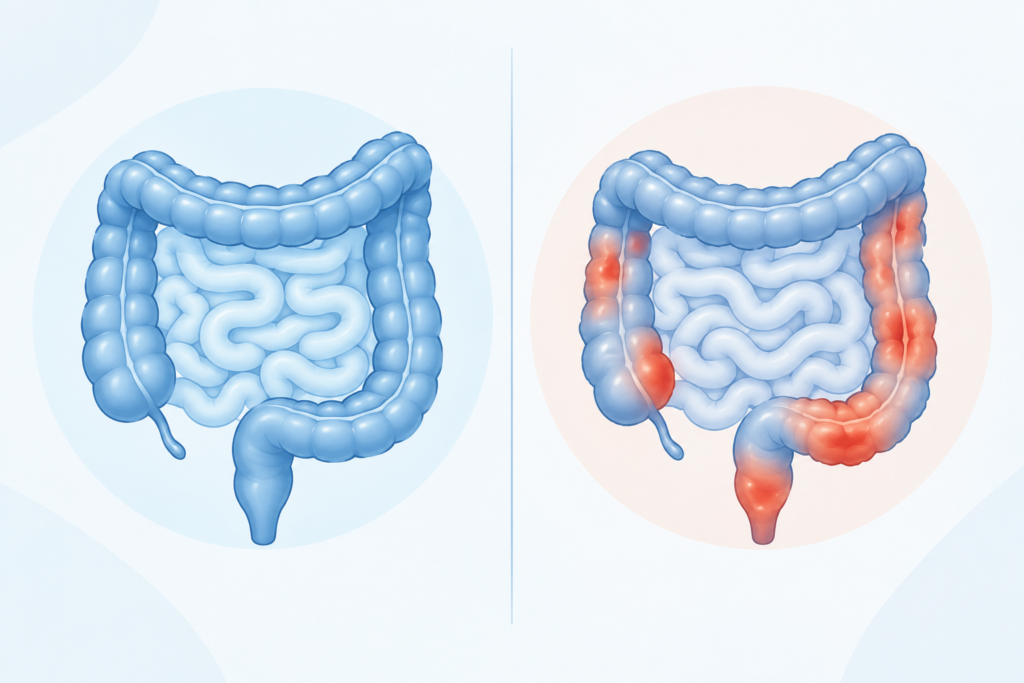
Two letters swapped, and suddenly you’re looking at two completely different diagnoses. IBS and IBD get confused constantly, not just by patients doing their own research at 11pm, but occasionally in casual conversation even among people who work in healthcare. The names sound almost interchangeable. The symptoms overlap just enough to make that confusion feel reasonable. And yet one of these conditions is manageable through diet and lifestyle changes, while the other involves actual inflammation and physical damage that, left untreated, can lead to surgery.
Why the Names Get Confused
IBS stands for irritable bowel syndrome. IBD stands for inflammatory bowel disease. Swap one letter and you’ve swapped the entire meaning of the diagnosis. Add to that the fact both conditions cause abdominal pain, changes in bowel habits, bloating, and fatigue, and it’s easy to see why even people managing one of these conditions for years sometimes aren’t entirely sure which category they fall into, or whether there’s overlap.
The short version: IBS is a functional disorder, meaning your gut isn’t working the way it should, but there’s no visible damage to find. IBD is a structural, inflammatory disease, meaning there’s actual, physical damage to the digestive tract that shows up on imaging, endoscopy, or biopsy. That single distinction changes everything about how each condition is diagnosed, treated, and monitored long term.
What Is IBS?
Irritable bowel syndrome is a chronic condition affecting how the large intestine functions. It falls under what doctors call a gut-brain disorder, meaning the nerve signaling between your digestive system and your brain doesn’t communicate normally, so ordinary digestive activity gets interpreted as pain or discomfort.
Common IBS symptoms include cramping, bloating, gas, and bowel habits that shift between constipation and diarrhea, or lean heavily toward one or the other. Despite how disruptive it can be day to day, IBS doesn’t damage the intestinal lining and doesn’t raise your risk of colon cancer. We’ve written a full breakdown of IBS symptoms, causes, and treatment options if you want to go deeper on that condition specifically.
What Is IBD?
Inflammatory bowel disease is an umbrella term covering two main conditions: Crohn’s disease and ulcerative colitis. Both involve the immune system mistakenly attacking healthy tissue in the digestive tract, triggering ongoing inflammation.
Crohn’s disease can affect any part of the digestive tract, from the mouth all the way to the anus, though it most commonly shows up in the small intestine and the beginning of the colon. The inflammation can penetrate through multiple layers of the intestinal wall, which is part of why Crohn’s can lead to complications like strictures (narrowed sections of the intestine) or fistulas (abnormal connections between organs).
Ulcerative colitis is more contained, affecting only the innermost lining of the colon and rectum, and typically spreading in a continuous pattern rather than in patches.
Both conditions are chronic, involve periods of flare-ups and remission, and require ongoing medical management. Unlike IBS, IBD carries a real risk of complications requiring hospitalization or surgery, and long-standing IBD does raise the risk of colon cancer over time, which is why regular monitoring through colonoscopy becomes such an important part of managing it.
IBS vs. IBD: The Core Difference
If you remember one distinction from this entire article, make it this one: IBD is structural, IBS is not.
When a gastroenterologist performs a colonoscopy on someone with IBD, the inflammation, ulceration, or damage is visible directly, and a biopsy will show inflammatory changes under the microscope. When that same colonoscopy is performed on someone with IBS, everything looks completely normal. There’s no damage to see, because IBS doesn’t cause any.
This is exactly why IBS is considered a diagnosis of exclusion in many cases. Doctors confirm it partly by ruling out conditions like IBD, celiac disease, and other structural issues, alongside matching your symptom pattern to established diagnostic criteria.
Symptom Comparison: IBS vs. IBD
| IBS | IBD | |
|---|---|---|
| Type of condition | Functional (no visible damage) | Structural (visible inflammation/damage) |
| Abdominal pain | Common, often eases after a bowel movement | Common, may persist regardless of bowel movements |
| Diarrhea or constipation | Common, often alternating | Diarrhea common, especially in flares |
| Blood in stool | Rare, not typical | Common during flares |
| Fever | Not typical | Can occur during active inflammation |
| Unintended weight loss | Uncommon | Common, especially with Crohn’s |
| Fatigue | Can occur, often tied to poor sleep or stress | Common, often tied to inflammation and nutrient malabsorption |
| Visible damage on colonoscopy | None | Present (ulceration, inflammation, strictures) |
| Risk of complications requiring surgery | Very low | Meaningful, particularly with Crohn’s disease |
| Long-term colon cancer risk | Not increased | Increased with long-standing disease |
The overlap in that table is exactly why symptoms alone aren’t enough to tell the two apart with confidence. The red flags, blood in the stool, fever, unintended weight loss, are the details that should always prompt a proper evaluation rather than an assumption either way.
How Doctors Actually Tell Them Apart
Since symptoms overlap, diagnosis relies on more than a conversation about how you’re feeling.
Blood work, checking for signs of inflammation, anemia, or nutritional deficiencies that are more commonly associated with IBD.
Stool testing, including a marker called fecal calprotectin, which tends to be elevated when there’s active intestinal inflammation, a useful way to flag IBD before more invasive testing.
Colonoscopy, the most definitive tool available. It allows direct visualization of the colon and, in many cases, the lower portion of the small intestine, along with the ability to take tissue samples for biopsy. If you’ve never had one and IBD is a possibility, this is genuinely the step that provides the clearest answer.
Imaging, such as CT or MRI enterography, sometimes used specifically for Crohn’s disease since it can affect sections of the small intestine that a standard colonoscopy doesn’t fully reach.
Can You Have IBS and IBD at the Same Time?
Here’s the part that gets surprisingly little attention, and it’s a genuinely important one: yes, you can have both conditions simultaneously, and it’s more common than most people realize.
Research suggests a meaningful percentage of people with IBD, particularly those in clinical remission with no active inflammation, continue to experience IBS-like symptoms such as cramping, bloating, and irregular bowel habits. This overlap sometimes gets described in clinical settings as IBD with IBS-like symptoms, and it creates a genuinely tricky situation. If your IBD is technically under control according to bloodwork and imaging, but you’re still having daily digestive symptoms, is that a sign your IBD treatment needs adjusting, or is it a separate, functional IBS layered on top?
There isn’t a simple universal answer, and this is exactly the kind of situation where working with a gastroenterologist who knows your full history matters far more than trying to self-diagnose based on symptoms alone. Treating it as purely an IBD flare when it’s actually an overlapping IBS component, or vice versa, can lead to the wrong treatment path and ongoing frustration. If you have diagnosed IBD and you’re still dealing with regular digestive symptoms despite your inflammation markers looking stable, that’s worth bringing up specifically at your next appointment rather than assuming it’s just “part of having IBD.”
Why Getting the Right Diagnosis Actually Matters
This isn’t just a technical distinction for its own sake. Treating IBD like IBS, or the reverse, has real consequences.
IBS treatment centers on diet, lifestyle changes, and symptom management. Applying that same light-touch approach to actual IBD means the underlying inflammation goes unaddressed, and untreated inflammation can progress, leading to complications like strictures, fistulas, or a significantly elevated cancer risk over time.
On the other hand, someone with IBS doesn’t need, and shouldn’t be on, the kind of immune-modulating medications used for IBD, which carry their own risks and side effects that aren’t justified without an actual inflammatory disease driving symptoms.
Getting an accurate diagnosis isn’t about labeling for its own sake. It’s what determines whether your treatment plan is actually addressing what’s going on inside your body.
Treatment: How the Two Diverge
IBS treatment typically involves dietary adjustments like a low-FODMAP approach, fiber management, stress reduction, and medications targeted at specific symptoms such as cramping or irregular bowel habits.
IBD treatment is built around controlling inflammation directly, often through anti-inflammatory medications, immune-modulating drugs, or biologic therapies, alongside regular monitoring through bloodwork, stool markers, and periodic colonoscopies to track how well the disease is controlled. In more advanced or complicated cases, surgery to remove damaged sections of the bowel becomes part of the conversation.
Neither of these treatment paths should be self-directed based on internet research. Both conditions benefit enormously from being managed by a gastroenterologist who can adjust the plan as things change.
When to See a Specialist
Certain symptoms should prompt an evaluation regardless of which condition you suspect:
- Blood in your stool, even occasionally
- Unexplained weight loss
- Persistent fever alongside digestive symptoms
- Diarrhea that wakes you up at night
- Abdominal pain that doesn’t ease up at all
- A family history of IBD, particularly if you’re developing new digestive symptoms
- Digestive symptoms that have lasted more than a few months without a clear diagnosis
Frequently Asked Questions
Can IBS turn into IBD over time?
No. IBS doesn’t progress into IBD. They’re distinct conditions with different underlying mechanisms, and having one doesn’t put you at increased risk of developing the other.
Does a normal colonoscopy rule out IBD completely?
It rules out most cases, since visible inflammation and damage are the hallmark of IBD. In rare situations, especially with Crohn’s disease affecting areas of the small intestine a standard colonoscopy doesn’t reach, additional imaging may still be needed if IBD remains a strong suspicion despite a normal colonoscopy.
Is IBD more serious than IBS?
In terms of physical risk, yes. IBD involves real tissue damage and carries risks like hospitalization, surgery, and increased cancer risk over time. That said, IBS shouldn’t be dismissed as minor. It can significantly affect quality of life even though it isn’t physically dangerous in the same way.
What blood test shows the difference between IBS and IBD?
No single blood test definitively separates the two, but markers like C-reactive protein and fecal calprotectin tend to be elevated with IBD and typically normal with IBS, making them useful pieces of the diagnostic picture alongside colonoscopy.
Get a Clear Answer in Conyers, GA
Guessing which condition you’re dealing with, or assuming a years-old IBS diagnosis still explains everything, isn’t a great long-term strategy when the treatment paths for IBS and IBD are this different. Dr. Shakoor and the team at CDH, supported by Joint Commission-accredited care through the affiliated Eastside Endoscopy Center, can walk you through proper testing and get you an actual answer instead of a guess.