
Here’s something that surprises most of our patients: colon cancer is largely preventable. Not just detectable early — actually preventable. And the reason comes down to one thing: colon polyps.
A polyp found during a colonoscopy and removed on the spot is a cancer that never gets to happen. That’s not a marketing line — it’s the biological reality of how colorectal cancer develops. Almost every case of colorectal cancer starts as a polyp that went undetected and, over a period of years, transformed into something dangerous.
The challenge is that most polyps produce no symptoms at all. They grow silently, which is exactly why so many people don’t know they have them until a routine screening colonoscopy finds one — or, in worse cases, until symptoms appear and the disease is already advanced.
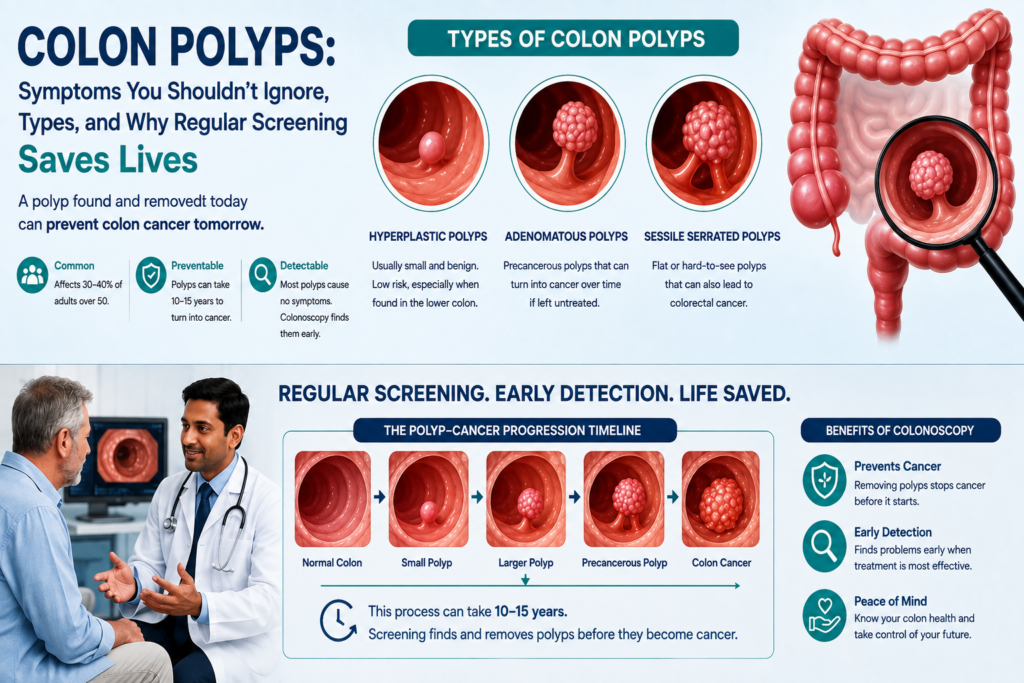
What Are Colon Polyps?
A colon polyp is an abnormal growth of tissue that develops on the inner lining of the large intestine (colon) or rectum. Think of them as small bumps or projections — they can be as tiny as a sesame seed or grow to be larger than a grape.
The critical thing to understand is that polyps are common. Very common. Roughly 30–40% of adults over 50 in the United States have at least one colon polyp, according to colonoscopy data. That number climbs higher with age. Most people who have a polyp removed have no idea they ever had one because it caused them no symptoms whatsoever.
The colon has no pain receptors capable of signaling a small growing polyp. Your body gives you no warning until complications arise — which, in some cases, means waiting until cancer is already present. This is why colonoscopy exists: to look inside the colon and catch what your body won’t tell you about on its own.
Types of Colon Polyps: Not All Are Created Equal
This is the part most online resources gloss over — but it’s genuinely important, because the type of polyp your doctor finds determines your cancer risk and how frequently you need follow-up colonoscopies.
1. Hyperplastic Polyps
Hyperplastic polyps are the most common type found during colonoscopy. They’re small, typically less than 5mm, usually appear in the left side of the colon (sigmoid colon and rectum), and are almost always benign.
The important detail: small hyperplastic polyps in the left colon have very low malignant potential and don’t change your follow-up schedule significantly. However, large hyperplastic polyps (10mm or greater) and hyperplastic polyps found in the right colon (ascending colon and cecum) are treated with more caution — they may be reclassified as serrated lesions, which do carry elevated risk.
2. Adenomatous Polyps (Adenomas) — The Most Important Category
Adenomas are the polyps that gastroenterologists take most seriously, because they are genuinely precancerous. Left alone and given enough time, some adenomas will progress to colorectal cancer. Adenomas are not cancer — but they have the potential to become cancer, which is why removing them is so important.
Adenomas are further classified by their internal structure:
Tubular adenomas are the most common adenoma subtype, making up roughly 80% of adenomas found. They’re typically smaller and have a lower risk of malignant transformation than the other subtypes — particularly when they’re small (less than 1cm) and found in limited numbers.
Villous adenomas have finger-like projections extending from their surface. They’re less common but carry a significantly higher risk of harboring cancer cells than tubular adenomas — particularly when large. Villous adenomas greater than 2cm have malignant potential upward of 40%.
3. Sessile Serrated Lesions (SSL) — The Sneaky Ones
Sessile serrated lesions (previously called sessile serrated adenomas or SSAs) deserve special attention because they’re responsible for a disproportionate share of “interval cancers” — cancers that develop between scheduled colonoscopies.
Here’s why they’re tricky: SSLs are flat, wide, and often covered by a mucus cap that makes them blend into the colon lining. They’re easy to miss, particularly in the right colon where they predominantly occur, and where the colon wall has more folds. An experienced, thorough endoscopist with excellent technique and adequate withdrawal time is more likely to find them.
4. Inflammatory Polyps
Inflammatory polyps (also called pseudopolyps) develop as a result of longstanding inflammation in the colon — most commonly in patients with ulcerative colitis or Crohn’s disease. They’re not themselves precancerous, but their presence in the context of IBD is a marker of significant prior inflammation, and these patients require heightened surveillance because IBD itself increases colorectal cancer risk over time.
5. Hamartomatous Polyps
Hamartomatous polyps are associated with rare hereditary syndromes — particularly Peutz-Jeghers syndrome and juvenile polyposis syndrome. These conditions require specialist management and genetic counseling, as they carry elevated risks not only for colorectal cancer but for cancers in other organs as well.
Colon Polyp Symptoms: What to Watch For
We want to be direct with you here: most colon polyps cause no symptoms at all. This isn’t a caveat or a disclaimer — it’s the central clinical reality that makes screening so essential. The absence of symptoms is the rule, not the exception.
That said, larger polyps or polyps in certain locations can produce symptoms. Knowing what to watch for is worthwhile — not because symptoms will reliably alert you to polyps, but because these signs should always prompt an evaluation regardless of their cause.
Rectal Bleeding or Blood in Stool
Blood in the stool is the symptom most commonly associated with colon polyps. It may appear as bright red blood on toilet paper, blood coating the stool, or darker blood mixed into the stool. It may also be invisible — detected only through a fecal occult blood test (FOBT) or fecal immunochemical test (FIT).
Here’s the important nuance: rectal bleeding is far more commonly caused by hemorrhoids or anal fissures than by polyps or cancer. But you cannot determine the source of rectal bleeding without a proper evaluation. Assuming bleeding is from hemorrhoids without confirming it is a mistake that delays cancer diagnoses every year.
Changes in Bowel Habits
A persistent change in how often you have bowel movements, or a change in stool consistency or caliber (narrowing of stool, sometimes described as pencil-thin stools), lasting more than a few weeks warrants investigation. This is particularly true if the change is new and unexplained by dietary changes or medication.
Large polyps, particularly in the left colon or rectum, can partially obstruct the passage of stool and alter bowel habits.
Abdominal Pain or Cramping
Most colon polyps don’t cause pain. When they do — particularly when the pain is associated with a specific area of the abdomen, is recurrent, and isn’t explained by other causes — it may signal a large polyp causing partial obstruction or a polyp that has ulcerated.
Mucus in Stool
Some polyps — particularly larger villous adenomas — produce mucus that can appear in or around the stool. This is not a common presentation, but it’s worth noting.
Who Is at Risk for Colon Polyps?
Understanding your personal risk helps determine when you should start screening and how frequently you need follow-up. Risk factors for developing colon polyps fall into two categories: those you can’t change and those you can.
Risk Factors You Cannot Change
Age is the strongest non-modifiable risk factor. Polyp prevalence rises steadily with age — roughly 25–30% of adults in their 50s have adenomas, and that percentage climbs significantly in the 60s and 70s.
Family history meaningfully increases risk. Having a first-degree relative (parent, sibling, or child) diagnosed with colorectal cancer or adenomatous polyps before age 60 approximately doubles your risk compared to the general population. Two or more first-degree relatives with colorectal cancer or advanced polyps increases risk further still.
Personal history matters too — if you’ve had adenomas before, you’re at higher risk of developing new ones. This is why post-polypectomy surveillance colonoscopies are tailored to your specific findings rather than being a flat 10-year interval.
Inflammatory bowel disease (IBD) — both Crohn’s disease and ulcerative colitis significantly increase colorectal cancer risk over time, particularly with long-standing disease and extensive colonic involvement. Patients with IBD require surveillance colonoscopy every 1–2 years after 8–10 years of disease.
Risk Factors You Can Change
Diet plays a documented role. Diets high in red and processed meat are associated with increased colorectal cancer risk. A diet rich in fiber, vegetables, and fruits is associated with reduced risk, partly through effects on the gut microbiome and transit time.
Physical inactivity is an independent risk factor — regular physical activity reduces colorectal cancer risk by approximately 25% in population studies.
Obesity, particularly central adiposity (belly fat), is associated with higher polyp risk through mechanisms involving insulin resistance and inflammation.
Smoking is a well-established risk factor for colorectal adenomas and cancer. The risk increases with duration and pack-years of smoking.
Heavy alcohol consumption — particularly more than two drinks per day — is associated with increased colorectal cancer risk.
How Are Colon Polyps Diagnosed?
Colonoscopy
Colonoscopy remains the most accurate, comprehensive test for detecting colon polyps. A thin, flexible tube with a high-definition camera at its tip is guided through the entire colon while you’re sedated, allowing your gastroenterologist to examine every centimeter of the colon lining. Crucially, any polyp found during colonoscopy can be removed during the same procedure — making colonoscopy simultaneously diagnostic and therapeutic.
Adenoma Detection Rate (ADR) — the percentage of screening colonoscopies during which at least one adenoma is found. This is perhaps the most important quality metric in gastroenterology. Studies consistently show that endoscopists with higher ADRs find more polyps and their patients develop fewer interval cancers.
Bowel preparation quality — a clean colon allows better visualization. An inadequate prep can obscure small polyps behind residual stool. This is why following your prep instructions carefully is not optional — it directly determines whether your doctor can see everything they need to see.
Stool-Based Tests
For patients who prefer to avoid or cannot access colonoscopy, stool-based tests offer alternatives:
Fecal Immunochemical Test (FIT) — detects blood in stool using antibodies specific to human hemoglobin. More accurate than the older guaiac FOBT. Must be performed annually. A positive FIT requires follow-up colonoscopy.
Flexible Sigmoidoscopy
Flexible sigmoidoscopy examines only the lower third of the colon (sigmoid colon and rectum). Because it misses the entire right side of the colon — where sessile serrated lesions predominantly occur — it is considered a less comprehensive screening option than colonoscopy
How Are Colon Polyps Removed?
When a polyp is found during colonoscopy, it’s typically removed immediately during the same procedure — this is called polypectomy
Cold snare polypectomy — a wire loop is passed around the polyp and closed to sever it cleanly, without electrocautery. This is the preferred technique for polyps 1–9mm and is associated with very low bleeding and perforation risk. Multiple studies have confirmed cold snare as the safest and most effective method for small polyps.
Endoscopic mucosal resection (EMR) — for large flat or sessile polyps (typically 20mm or larger), saline or other solution is injected under the polyp to lift it away from the colon wall, creating a cushion that allows safer piecemeal removal. Large polyps removed in pieces (piecemeal EMR) require closer follow-up to confirm complete removal.
Surgery — when a polyp cannot be removed endoscopically (due to size, location, or concern for invasion into the colon wall), surgical resection may be required. This is uncommon but necessary in certain cases.
What Happens After Polyps Are Removed?
After removal, every polyp is sent to a pathologist who examines it under a microscope and issues a pathology report. Your gastroenterologist uses this report to classify your findings and determine when your next colonoscopy should be.
Follow-Up Colonoscopy Intervals
The U.S. Multi-Society Task Force on Colorectal Cancer (USMSTF) publishes evidence-based guidelines for surveillance intervals after polypectomy. Here’s what current guidance says:
| Finding | Recommended Follow-Up |
|---|---|
| No polyps (normal colonoscopy) | 10 years |
| 1–2 small tubular adenomas (< 10mm) | 7–10 years |
| 3–4 small adenomas | 3–5 years |
| 5–10 adenomas | 3 years |
| Adenoma ≥ 10mm | 3 years |
| Adenoma with villous features or high-grade dysplasia | 3 years |
| > 10 adenomas | < 3 years; consider hereditary syndrome evaluation |
| SSL < 10mm, no dysplasia | 5 years |
| SSL ≥ 10mm, or any SSL with dysplasia | 1–3 years |
| Traditional serrated adenoma | 3 years |
| Piecemeal removal of large polyp | 6 months (to confirm complete removal) |
Colorectal Cancer Screening Guidelines: When to Start, When to Screen More Often
The rates of diagnosis in people under the age of 55 have been steadily increasing. To improve the chances of finding colorectal cancer in earlier stages and in a younger population, the recommended screening age was recently lowered to 45.
Screening options for average-risk adults:
- Colonoscopy every 10 years (if normal) — preferred because it’s diagnostic and therapeutic in one visit
- Annual FIT test — highly sensitive for cancer; must be done every year
- Cologuard every 3 years — stool DNA test; positive result requires colonoscopy
Higher Risk — Earlier and More Frequent Screening
Colorectal cancer screening should begin with a colonoscopy at age 40, or 10 years before the youngest affected relative, whichever is earlier, in individuals in whom a first-degree relative has had colorectal cancer or an advanced polyp before age 60 years, or in whom two or more first-degree relatives have had colorectal cancer or an advanced polyp at any age; with interval colonoscopy every 5 years
Colon Polyps and Diet: Can You Reduce Your Risk?
While you can’t control your age or family history, dietary choices have documented effects on adenoma risk. Here’s what the evidence actually supports — not health blog speculation, but findings from large-scale prospective studies:
Increase these:
- Dietary fiber — multiple studies show inverse associations between fiber intake and colorectal adenoma risk. Aim for 25–38 grams per day from whole foods (vegetables, fruits, legumes, whole grains), not supplements.
- Calcium — dairy calcium and supplemental calcium have both shown modest protective effects against adenoma recurrence in randomized trials. Whether this benefit extends to calcium from supplements vs. food is still debated, but dietary calcium from low-fat dairy and leafy greens is beneficial for multiple reasons.
- Vitamin D — low serum vitamin D is associated with higher colorectal cancer risk in multiple observational studies. Maintaining adequate vitamin D levels (generally 30–50 ng/mL) through diet, sunlight, or supplementation is reasonable.
- Fish (omega-3 fatty acids) — regular fish consumption is associated with modest reduction in colorectal cancer risk in large cohort studies.
- Physical activity — this isn’t diet, but it’s worth including here because exercise independently reduces adenoma recurrence risk and colorectal cancer incidence by approximately 25% in population studies. You don’t need to run marathons — 150 minutes of moderate-intensity activity per week is the threshold most associated with benefit.
Reduce these:
- Red and processed meat — the World Health Organization classifies processed meat as a Group 1 carcinogen (sufficient evidence of causing colorectal cancer in humans) and red meat as Group 2A (probably carcinogenic). The association is dose-dependent — higher consumption correlates with higher risk.
- Alcohol — even moderate alcohol intake is associated with increased colorectal cancer risk. The risk increases substantially with heavy consumption.
- Ultra-processed foods — highly processed diets high in refined carbohydrates, additives, and low in fiber are associated with both higher polyp risk and altered gut microbiome composition.
Expert Colorectal Screening in Conyers, GA
At Colon & Digestive Health Specialists, Dr. Karim Shakoor, M.D. and our team perform colonoscopies with the attention to detail that makes a real difference in adenoma detection rates. We use high-definition colonoscopes, follow evidence-based withdrawal time standards, and take the time to examine every area of the colon thoroughly — because the whole point is to find what’s there, not just do a quick pass.