
The moment a patient hears the phrase “colon cancer,” the world stops. It’s an emotional and frightening experience. The very next question, often unspoken, is, “What kind do I have, and what does it mean for me?” Understanding the different types of colon cancer is the vital first step toward developing an effective treatment plan and establishing a prognosis. As Colon & Digestive Health specialists, our purpose is to move beyond the initial diagnosis, offering you a clear, expert roadmap to comprehending the precise nature of your condition, from its specific cellular subtype to its broader stage. This comprehensive guide will illuminate the critical differences between the cancers that can arise in the colon, providing the genuine, trustworthy information you need to move forward with confidence.
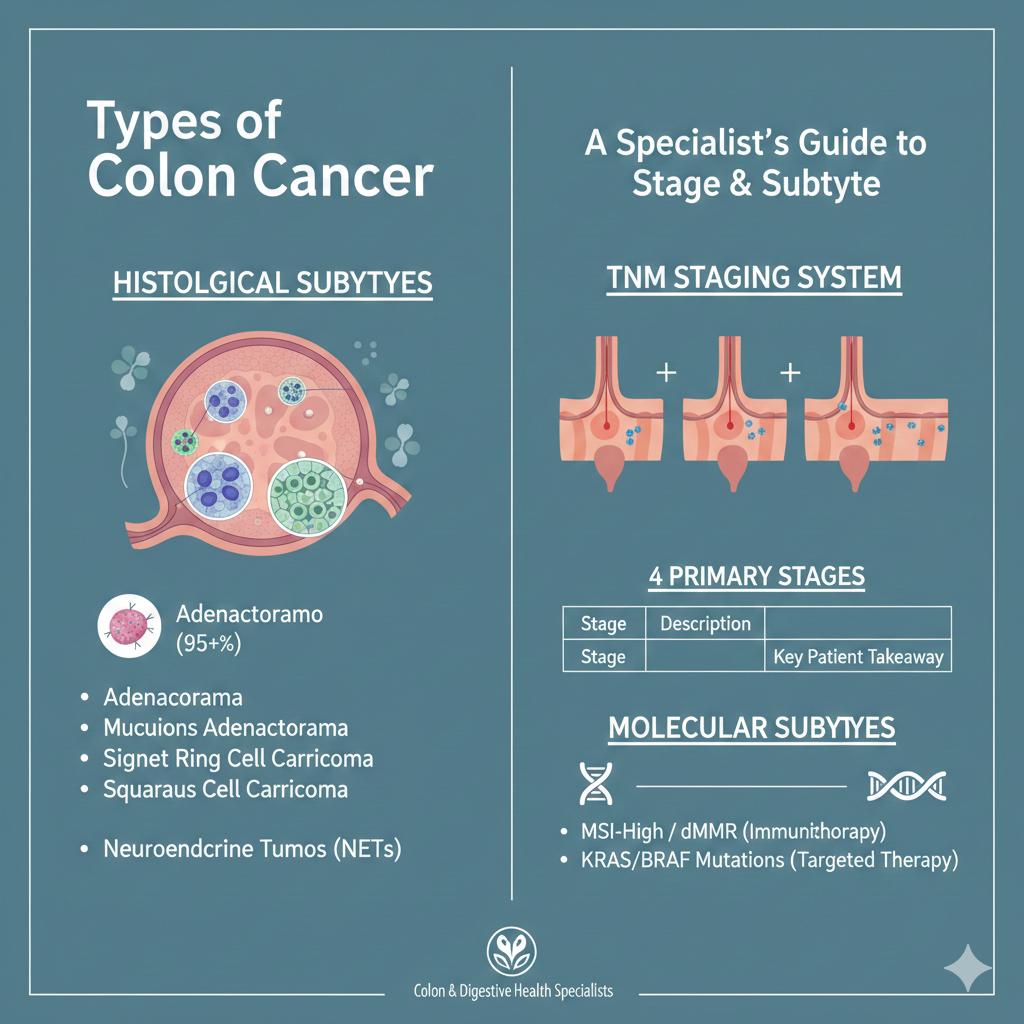
The Main Types of Colon Cancer: Histological Subtypes
While most people refer to the disease simply as “colon cancer” or “colorectal cancer,” it is medically classified into distinct subtypes based on the cell type where the cancer originates. This classification is known as histopathology and is the foundation for selecting the right treatment.
Adenocarcinoma: The Most Common Colon Cancer
The vast majority (over 95%) of all colorectal cancers fall into this category.
- What it is: Adenocarcinoma arises in the glandular cells that line the inside of the colon and rectum, which are responsible for producing mucus. It almost always begins as a non-cancerous growth called an adenomatous polyp. Over years, genetic changes can cause the cells in the polyp to become malignant.
- Significance for Patients: Because it is so common, there is a wealth of research and established, highly effective treatment protocols for adenocarcinoma. Early detection through regular colonoscopy and polyp removal is the single most effective way to prevent this specific type of cancer from ever developing.
Rare but Critical Subtypes of Colorectal Cancer
While far less common, these subtypes require a unique approach due to their different growth patterns and response to therapy. These often become the focus of specialized research and treatment.
- Mucinous Adenocarcinoma: This is a distinct variation of adenocarcinoma where more than half of the tumor mass is composed of mucus.
- Clinical Impact: Mucinous tumors are often more challenging to detect on routine imaging and may have a different response to conventional chemotherapy regimens. They tend to occur more frequently in the right side of the colon.
- Signet Ring Cell Carcinoma: This is a highly aggressive and rare form, accounting for less than 1% of cases. When viewed under a microscope, the cancer cells resemble a signet ring, with the nucleus pushed to the side by a large mucin droplet.
- Clinical Impact: It grows diffusely, infiltrating the colon wall rather than forming a distinct lump. This aggressive nature often leads to a later-stage diagnosis and generally carries a poorer prognosis, requiring intensive and specialized treatment.
- Squamous Cell Carcinoma: While common in the skin, lung, and esophagus, it is exceedingly rare in the colon and rectum.
- Neuroendocrine Tumors (NETs) of the Colon: These tumors arise from specialized cells that release hormones. They can range from slow-growing (low-grade) to highly aggressive (high-grade). Their management is often unique, sometimes involving treatments targeted at hormone production.
Understanding Stage: Why TNM Classification is Crucial
he type of colon cancer tells us what the cancer is, but the stage tells us how far it has progressed. Staging is arguably the most crucial factor in determining the most effective treatment plan, the overall prognosis, and the required surgical approach.
The TNM Staging System: The Universal Standard
Specialists use the American Joint Committee on Cancer (AJCC) TNM classification system to define the stage. This universal language for cancer staging is essential for clinical trials and specialist communication.
- T (Tumor): Describes the size of the original tumor and how deeply it has grown into the layers of the colon wall.
- Example: A T1 tumor has grown only into the submucosa (the layer beneath the inner lining), while a T4 tumor has grown through the entire colon wall or into nearby organs.
- N (Nodes): Indicates whether the cancer has spread to nearby lymph nodes and, if so, how many.
- Example: N0 means no spread, N1 means spread to 1-3 regional lymph nodes, and N2 means spread to 4 or more regional lymph nodes.
- M (Metastasis): Describes whether the cancer has spread (metastasized) to distant organs, such as the liver or lungs.
- Example: M0 means no distant spread, and M1 means the cancer has spread to distant sites.
The 4 Primary Stages of Colon Cancer
| Stage | Description | Key Patient Takeaway |
| Stage 0 | Abnormal cells only in the innermost layer (in situ). | Highly treatable, often curable with local excision (polyp removal). |
| Stage I | Cancer has grown into the deeper layers of the wall but not through the wall and no spread to lymph nodes. | Excellent prognosis; usually treated with surgery alone. |
| Stage II | Cancer has grown through the colon wall (T3 or T4) but has not spread to lymph nodes (N0). | May require additional chemotherapy after surgery (adjuvant therapy), depending on specific risk factors. |
| Stage III | Cancer has spread to nearby lymph nodes (N1 or N2) but not to distant organs (M0). | Requires a combination of surgery and aggressive chemotherapy to reduce the risk of recurrence. |
| Stage IV | Cancer has spread (metastasized) to distant organs (M1), such as the liver, lungs, or peritoneum. | Treatment is complex, often involves systemic therapies (chemo, targeted therapy, immunotherapy), and sometimes surgery to remove metastatic sites. |
Advanced Molecular Subtypes: The Future of Colon Cancer Treatment
In the last decade, our understanding has evolved far beyond simple staging. Modern, specialist-led digestive health centers now use molecular subtyping to guide therapy, which is often the key to unlocking better outcomes. This is critical for predicting how the tumor will respond to specific drugs.
Genomic Biomarkers in Colorectal Cancer
The most high-volume and clinically relevant secondary keywords in this area are the specific biomarkers that patients and their families frequently search for when reviewing their pathology reports.
Microsatellite Instability (MSI) and Mismatch Repair (MMR)
What it is: Microsatellite instability (MSI) is a condition where defects in the cell’s Mismatch Repair (MMR) system prevent it from correctly fixing DNA errors. This results in numerous genetic mutations within the tumor.
Clinical Impact: Tumors that are MSI-High (MSI-H) or dMMR (deficient MMR) often have a favorable prognosis in early stages and are highly responsive to immunotherapy in later stages. This is a game-changer in treatment planning, as immunotherapy can offer long-lasting control for some patients with metastatic disease.
The Significance of KRAS and BRAF Mutations
- What it is: These are common mutations found in the genes KRAS and BRAF, which drive cell growth and division.
- Clinical Impact: The presence of a KRAS mutation often indicates that a tumor will not respond to a class of targeted drugs known as EGFR inhibitors. Detecting a BRAF V600E mutation often suggests a more aggressive form of the cancer, which requires a specific combination of targeted and standard chemotherapy to address. Knowing these results allows specialists to immediately rule out ineffective treatments and zero in on the most promising regimens.
Our Commitment to Expert-Driven Care
Navigating the complexities of types of colon cancer—from rare histological subtypes to nuanced molecular findings—demands a team dedicated to the highest standards of medical practice. Our specialists at Colon & Digestive Health are leaders in the field, with decades of collective experience in diagnosing and treating all stages of colorectal cancer.
Our commitment to precise, authoritative care means:
- Evidence-Based Practice: We strictly adhere to and contribute to the latest national and international guidelines, including those set by the National Comprehensive Cancer Network (NCCN) and the American Joint Committee on Cancer (AJCC), ensuring every treatment plan is grounded in the most current, effective research.
- Specialized Expertise: Our clinicians hold advanced certifications in Gastroenterology and Surgical Oncology, providing the deep technical knowledge required for complex procedures, challenging pathology reviews, and personalized genetic risk assessments.
- Patient-Centered Trust: We believe in absolute transparency and compassion. Every diagnosis, recommendation, and conversation is delivered clearly, building the essential trust you need to confidently manage your health crisis.
if you or a loved one has recently received a colon cancer diagnosis, you need clarity, not confusion. Don’t wait to understand the full implications of your unique stage and subtype.
Contact Colon & Digestive Health Specialists in Conyers, GA today to schedule a comprehensive second opinion or to begin your diagnostic process. Let us provide the expert clarity and personalized treatment roadmap you need for a confident future.