
Colon cancer is one of the most common cancers affecting adults in the United States, yet it is also one of the most preventable and treatable when detected early. Unfortunately, many people overlook subtle warning signs, assuming they are caused by minor digestive issues, stress, or aging.
If you are 40 or older, understanding what your body is telling you could be the most important thing you read today. This guide walks you through every key warning sign, who is most at risk, and exactly when you should call a gastroenterologist.
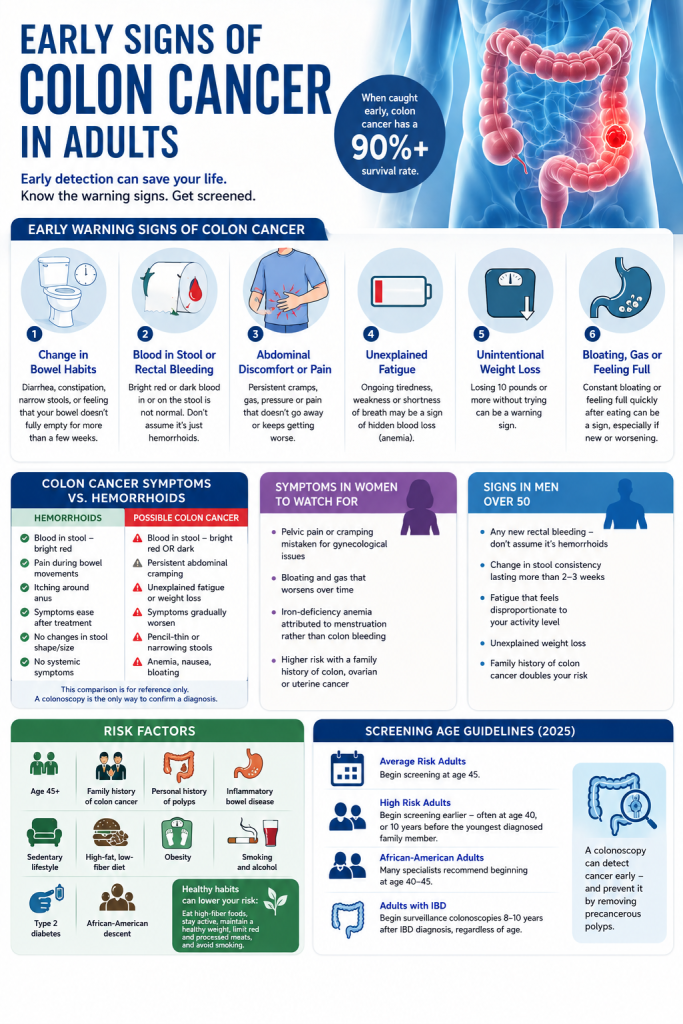
Early colon cancer often causes no pain. The most common early warning signs include changes in bowel habits, blood in the stool, unexplained fatigue, and unintentional weight loss. Many of these symptoms overlap with other digestive conditions — which is exactly why a proper diagnosis matters.
Colorectal Cancer vs. Colon Cancer: Is There a Difference?
You may have heard the terms colorectal cancer and colon cancer used interchangeably. Here is the simple distinction: colorectal cancer is the umbrella term for cancers that develop in either the colon or the rectum. Colon cancer specifically originates in the large intestine (colon). Both begin the same way — usually as a small, non-cancerous growth called a polyp — and both share many of the same early warning signs.
For the purposes of this guide, we will use both terms. All symptoms and risk factors discussed apply to the full colorectal spectrum.
Early Warning Signs of Colon Cancer You Should Never Ignore
1. A Persistent Change in Bowel Habits
One of the most telling early signs of colon cancer in adults is a noticeable, lasting change in how often you go to the bathroom — or what your stool looks like. Watch for:
- Diarrhea or constipation that lasts more than four weeks
- Stool that is narrower than usual (sometimes described as pencil-thin)
- Feeling that your bowel does not fully empty after a bathroom visit
- Alternating between diarrhea and constipation without explanation
This sign is frequently confused with irritable bowel syndrome. Understanding the difference between colon cancer and IBS symptoms is critical: IBS symptoms typically come and go over years and are linked to stress or food triggers. A colon cancer-related bowel change tends to be progressive and does not resolve on its own.
2. Blood in the Stool or Rectal Bleeding
Rectal bleeding is one of the most common reasons patients finally visit a gastroenterologist. Many adults assume blood in the stool means hemorrhoids — a very common condition. But here is why you cannot skip the evaluation: colon cancer and hemorrhoids can both cause rectal bleeding, and distinguishing between them requires a proper examination.
See a doctor promptly if you notice:
- Bright red blood on toilet paper or in the toilet bowl
- Dark, tarry, or maroon-colored stools — a potential sign of bleeding higher in the colon
- Any rectal bleeding that is new, unexplained, or recurring
A quick rule of thumb: hemorrhoid bleeding is usually bright red and associated with straining. Dark, mixed-in blood is more concerning and warrants immediate medical evaluation.
3. Unexplained Abdominal Discomfort or Pain
When patients ask what does colon cancer pain feel like, the honest answer is: it varies widely. Early-stage colon cancer pain may feel like:
- Persistent cramping or gas that does not go away
- A dull ache or pressure in the lower abdomen
- Sharp pain that comes and goes without a clear trigger
Unlike the cramping caused by gas or IBS, colon cancer-related pain tends to be more consistent over time and may gradually worsen.
4. Unexplained Fatigue and Weakness
This symptom surprises many patients. Colon cancer can cause slow, chronic blood loss from a bleeding polyp or tumor — often before any visible blood appears in the stool. This hidden blood loss leads to iron-deficiency anemia, producing:
- Persistent fatigue that does not improve with rest
- Shortness of breath during light activity
- Pale skin or a pale inner lower eyelid
If your doctor discovers unexplained anemia during a routine blood test, requesting a colonoscopy is a reasonable and important next step.
5. Unintentional Weight Loss
Losing 10 or more pounds without changing your diet or exercise habits is a red flag for several cancers, including colon cancer. The tumor may be altering the way your body absorbs nutrients, or your immune system’s response to the cancer may be accelerating your metabolism.
| Hemorrhoid symptoms | Possible colon cancer symptoms |
| Blood in stool — bright red | Blood in stool — bright red OR dark |
| Pain during bowel movements | Persistent abdominal cramping |
| Itching or discomfort around anus | Unexplained fatigue or weight loss |
| Symptoms ease after treatment | Symptoms gradually worsen |
| No changes in stool shape/size | Pencil-thin or narrowing stools |
| No systemic symptoms | Anemia, nausea, bloating |
Symptoms of Colon Cancer in Women vs. Men
Symptoms of Colon Cancer in Women
Women are sometimes diagnosed later than men because certain symptoms of colon cancer in women overlap with gynecological conditions. Women may attribute abdominal cramping to menstrual issues or bloating to dietary factors, delaying a GI evaluation. Additionally, women are less likely to report rectal bleeding to their doctor. Key female-specific considerations:
- Pelvic pain or cramping sometimes mistaken for endometriosis or ovarian issues
- Bloating and gas that worsens progressively over months
- Iron-deficiency anemia attributed to menstruation rather than colon bleeding
Women who have a family history of colon cancer, or who have had ovarian or uterine cancer, carry a higher risk and should prioritize screening.
Signs of Colon Cancer in Men Over 50
The signs of colon cancer in men over 50 are largely the same, but men in this age group are statistically more likely to be diagnosed. Men are often less proactive about seeking medical care for digestive symptoms, which leads to later-stage diagnoses. Men over 50 should pay particular attention to:
- Any new rectal bleeding — do not assume it is hemorrhoids without an exam
- A change in stool consistency lasting more than two to three weeks
- Fatigue that feels disproportionate to your activity level
- Any first-degree relative (parent, sibling) with colon cancer — your risk doubles
Colon Cancer Risk Factors by Age — Who Is Most at Risk?
Understanding your personal risk profile helps you decide when and how often to screen. Here are the major risk factors:
| Risk factor | What it means for you |
| Age 45+ | Risk increases significantly — average-risk adults should begin screening |
| Family history | First-degree relative with colon cancer doubles your risk |
| Personal history of polyps | Previous polyps dramatically raise recurrence risk |
| Inflammatory bowel disease | Ulcerative colitis and Crohn’s disease increase risk after 8–10 years |
| Sedentary lifestyle | Physical inactivity is an independent risk factor |
| High-fat, low-fiber diet | Red and processed meat consumption elevates risk |
| Obesity | BMI over 30 raises colon cancer risk by up to 30% |
| Smoking and alcohol | Both have documented links to colorectal cancer |
| Type 2 diabetes | Associated with up to 40% higher colorectal cancer risk |
| African-American descent | Higher incidence rate — screening recommended starting at age 40–45 |
When Should You Get a Colonoscopy? Screening Age Guidelines
The most important thing you can do if you notice any of the symptoms above — or if you are approaching the screening age — is schedule a colonoscopy. Here are the colon cancer screening age guidelines recommended by major U.S. medical organizations in 2025:
- Average risk adults: Begin screening at age 45. (The American Cancer Society lowered the recommended start age from 50 to 45 in 2018 due to rising rates in younger adults.)
- High risk adults: Begin screening earlier — often at age 40, or 10 years before the youngest diagnosed family member.
- African-American adults: Many specialists recommend beginning at age 40–45 due to higher incidence and younger average age at diagnosis.
- Adults with IBD: Begin surveillance colonoscopies 8–10 years after IBD diagnosis, regardless of age.
A standard colonoscopy not only detects cancer — it can prevent it by removing precancerous polyps during the same procedure. Many patients who are anxious about the process find it far less uncomfortable than expected, especially with modern sedation options.
Your Next Step: Schedule a Screening Today
If any of the symptoms in this guide sound familiar — or if you are 45 or older and have not had your first colonoscopy — there has never been a better time to act. Early detection does not just improve your odds. In many cases, it is the difference between a 20-minute procedure to remove a polyp and months of cancer treatment.
If you’re experiencing concerning symptoms or are due for screening, the specialists at Colon & Digestive Health Specialists can help you take the next step toward better digestive health.