
If you walk down the health aisle of any grocery store , you’re met with a wall of colorful bottles promising “optimal gut health,” “immune support,” and “digestive balance.” Probiotics have become a multi-billion dollar industry, but as a patient, you’re likely left with one burning question: Do they actually work, or is it just expensive bacteria?
At Colon & Digestive Health Specialists, we see patients every day who are self-treating with over-the-counter (OTC) supplements. While the “gut microbiome” is the frontier of modern medicine, the reality of probiotics is more nuanced than a marketing label suggests.
Here is what our board-certified gastroenterologists at Eastside Endoscopy Center want you to know before you take your next capsule.
Understanding the Microbiome: Your Inner Ecosystem
To understand if probiotics work, you first have to understand what they are trying to fix. Your gut is home to trillions of microorganisms—bacteria, fungi, and viruses—collectively known as the microbiome.
When this ecosystem is balanced, your digestion is smooth, your immune system is sharp, and even your mood is stabilized. However, factors like a poor diet, high stress, or a round of antibiotics can cause dysbiosis—an imbalance where “bad” bacteria outnumber the “good.”
The Clinical Truth: Do Probiotics Actually Work?
The short answer is: Yes, but with a major asterisk.
Probiotics are not a “one-size-fits-all” miracle pill. Their effectiveness depends entirely on three factors:
- The Strain: Different strains do different jobs.
- The CFU Count: Colony Forming Units (CFUs) determine the potency.
- The Condition: Are you treating occasional bloating, or are you managing Ulcerative Colitis?
Where Probiotics Shine
Clinical research supports the use of specific probiotics for:
- Antibiotic-Associated Diarrhea: Taking probiotics during a course of antibiotics can help prevent the “wipeout” of good bacteria.
- Infectious Diarrhea: Certain strains can shorten the duration of stomach bugs.
- IBS Management: For many patients in our Conyers clinic, specific strains like Bifidobacterium infantis have shown success in reducing bloating and gas.
What the Labels Don’t Tell You
As gastroenterologists, our concern with the “probiotic craze” stems from the lack of regulation. Because these are sold as supplements, they aren’t held to the same rigorous FDA standards as the medications we prescribe at Eastside Endoscopy Center.
1. The “Dead on Arrival” Problem
Probiotics are living organisms. They are sensitive to heat, light, and stomach acid. Many off-the-shelf supplements lose their potency before they ever reach your lower intestine.
2. More Isn’t Always Better
A supplement boasting “50 Billion CFUs” isn’t necessarily better than one with 5 Billion. If the 50 Billion are the wrong strains for your specific GI profile, they won’t provide relief.
3. The Risk of SIBO
In some cases, introducing more bacteria—even “good” bacteria—into a gut that is already imbalanced can lead to Small Intestinal Bacterial Overgrowth (SIBO), actually worsening symptoms like extreme bloating and pain.
A Food-First Approach to Gut Health
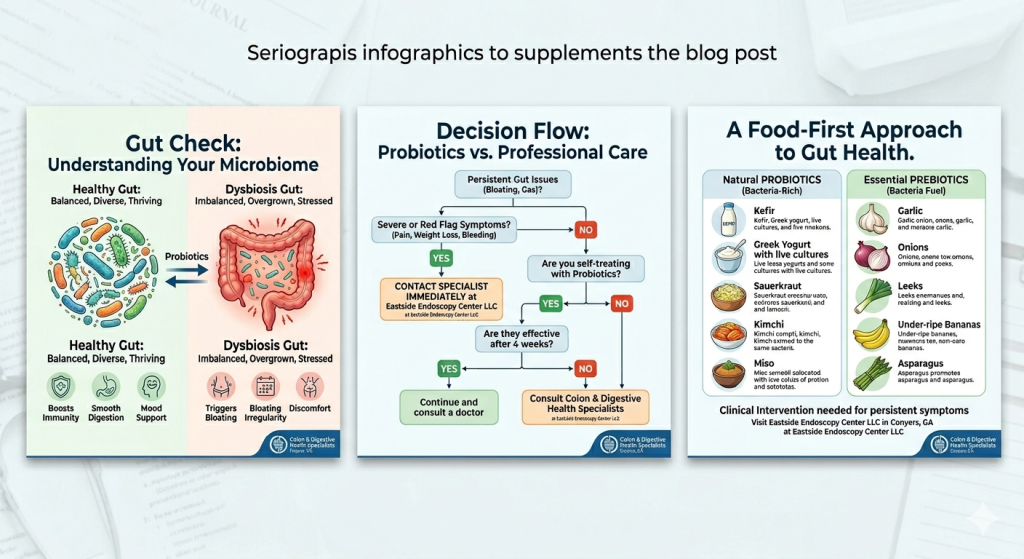
Before reaching for a supplement, our specialists often recommend focusing on Prebiotics. While probiotics are the “seeds,” prebiotics are the “fertilizer.”
Incorporating naturally fermented foods can often provide a more diverse array of bacteria than a single pill:
- Kefir and Yogurt: Look for “Live and Active Cultures.”
- Sauerkraut and Kimchi: Ensure they are refrigerated (not canned) to keep the bacteria alive.
- Fiber-rich foods: Garlic, onions, and bananas feed the healthy bacteria already in your gut.
When to Stop Supplementing and Start Screening
Probiotics can mask symptoms of more serious underlying issues. If you are taking supplements to manage persistent pain, changes in bowel habits, or unexplained weight loss, it is time for a professional evaluation.
At Eastside Endoscopy Center LLC, we provide comprehensive diagnostic services, including colonoscopies and EGDs, to ensure that “bloating” isn’t actually a sign of something that requires clinical intervention.
Take Control of Your Digestive Health in Conyers
Don’t guess when it comes to your gut health. If you’re struggling with digestive discomfort, the team at Colon & Digestive Health Specialists is here to help you move beyond supplements and find lasting solutions.
At Colon & Digestive Health Specialists, we provide personalized care plans designed to address both digestive health and stress-related triggers.